Is Intersectionality Selective? The Role of Collider Bias
By Nasir Bashir • Jul 28, 2026 • methods related
Why This Matters
Intersectionality is a framework for understanding how multiple social characteristics - such as gender, race, ethnicity, and socioeconomic position - combine to shape people’s experiences of health and inequality. Researchers often use statistical methods, including interaction models and Multilevel Analysis of Individual Heterogeneity and Discriminatory Accuracy (MAIHDA), to identify whether some groups experience greater advantage or disadvantage than would be expected from considering each characteristic separately.
These methods are increasingly used to identify populations that may require targeted interventions. However, an important assumption is often overlooked: that the people included in a study represent the wider population researchers want to understand. In reality, many studies rely on selected samples, such as volunteers, people attending clinics, or participants who respond to surveys. These selection processes are rarely random and may themselves depend on both social characteristics and health outcomes.
When this happens, a type of statistical bias known as collider bias can arise. Collider bias can create, exaggerate, reduce, or even reverse apparent inequalities that do not reflect the true relationships in the population. We investigated whether these selection processes could produce misleading evidence of intersectional inequalities.
What Was Done
We used directed acyclic graphs alongside large-scale Monte Carlo simulations to examine how selection into a study influences estimates of intersectional inequalities. We created simulated populations where the outcome was completely unrelated to the social characteristics being studied, meaning there were no true intersectional differences in the underlying population.
We then simulated different ways people might be selected into a study, such as when participation depended on gender, race, the combination of both characteristics, the health outcome itself, and combinations of these factors. We analysed the selected samples using two of the most common quantitative approaches to studying intersectionality: regression models with interaction terms and MAIHDA.
We validated this theory across more than 28,000 simulation scenarios, examining whether these methods identified intersectional inequalities that were actually created by the selection process rather than reflecting the underlying population.
Key Findings
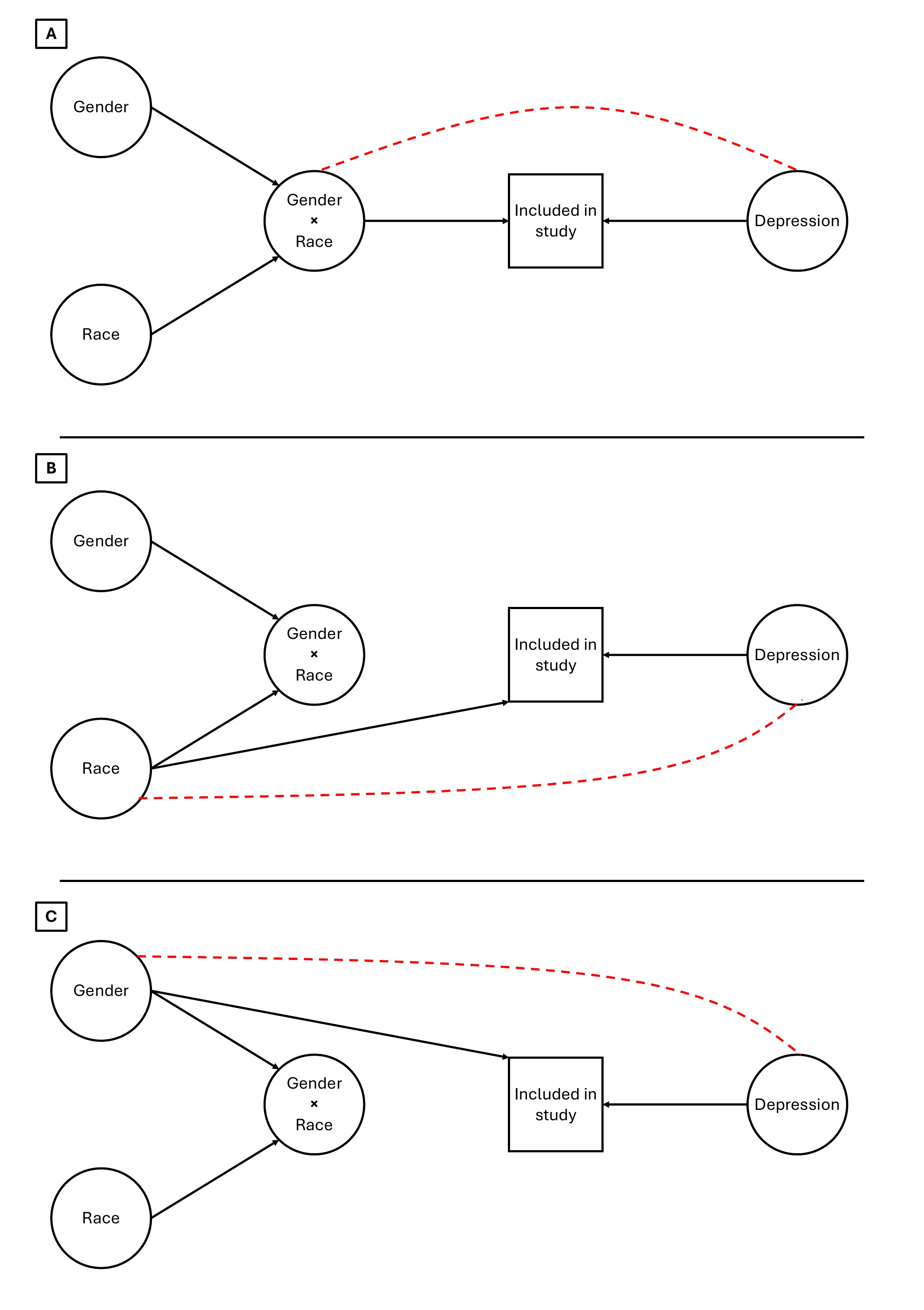
Figure 1. Directed acyclic graphs showing how selection into a study can act as a collider and induce spurious associations between social characteristics and health outcomes. Red dashed lines represent induced associations.
Directed acyclic graphs in Figure 1 show how selection into a study can act as a collider, inducing spurious associations between social characteristics and health outcomes.
Simulation results showed that stronger selection processes consistently generated larger apparent interaction effects and greater between-group heterogeneity, despite no true intersectional inequalities existing in the population. These patterns were often non-monotonic and difficult to predict a priori.
Selection processes alone were able to generate apparent intersectional inequalities, even when none existed in the underlying population. Collider bias affected both regression models with interaction terms and MAIHDA, demonstrating that the problem is not specific to one analytical method. Because selection changes the observed data itself, it can bias not only interaction estimates but also broader descriptions of inequalities across intersectional groups.
What This Means for Equity
Our findings demonstrate that observed intersectional inequalities (or equalities) do not always reflect genuine social processes. Instead, they may sometimes arise because of how participants enter a study. This is particularly important because quantitative intersectionality is increasingly used to identify disadvantaged populations, guide resource allocation, and inform public health policy.
The results do not suggest that intersectional inequalities are unimportant or unreal. Rather, they highlight the importance of distinguishing genuine inequalities from patterns introduced through selection into the analysed sample. Failure to consider selection mechanisms may lead researchers to overestimate, underestimate, or misinterpret inequalities between intersectional groups.
These findings have important implications for future research. Researchers should carefully consider whether the people included in their studies are representative of the target population, explicitly evaluate potential selection mechanisms, and conduct sensitivity analyses to assess how selection may influence their findings.
From a policy perspective, decisions based on quantitative intersectionality research should be interpreted alongside an understanding of how study participants were selected. Strengthening study design and improving transparency around selection processes will help ensure that evidence used to inform health equity policies more accurately reflects the populations these policies are intended to serve.
Publication
Bashir NZ, Al-Kassab-Córdova A. Is intersectionality selective? The role of collider bias. Social Science & Medicine. 2026;404:119550.